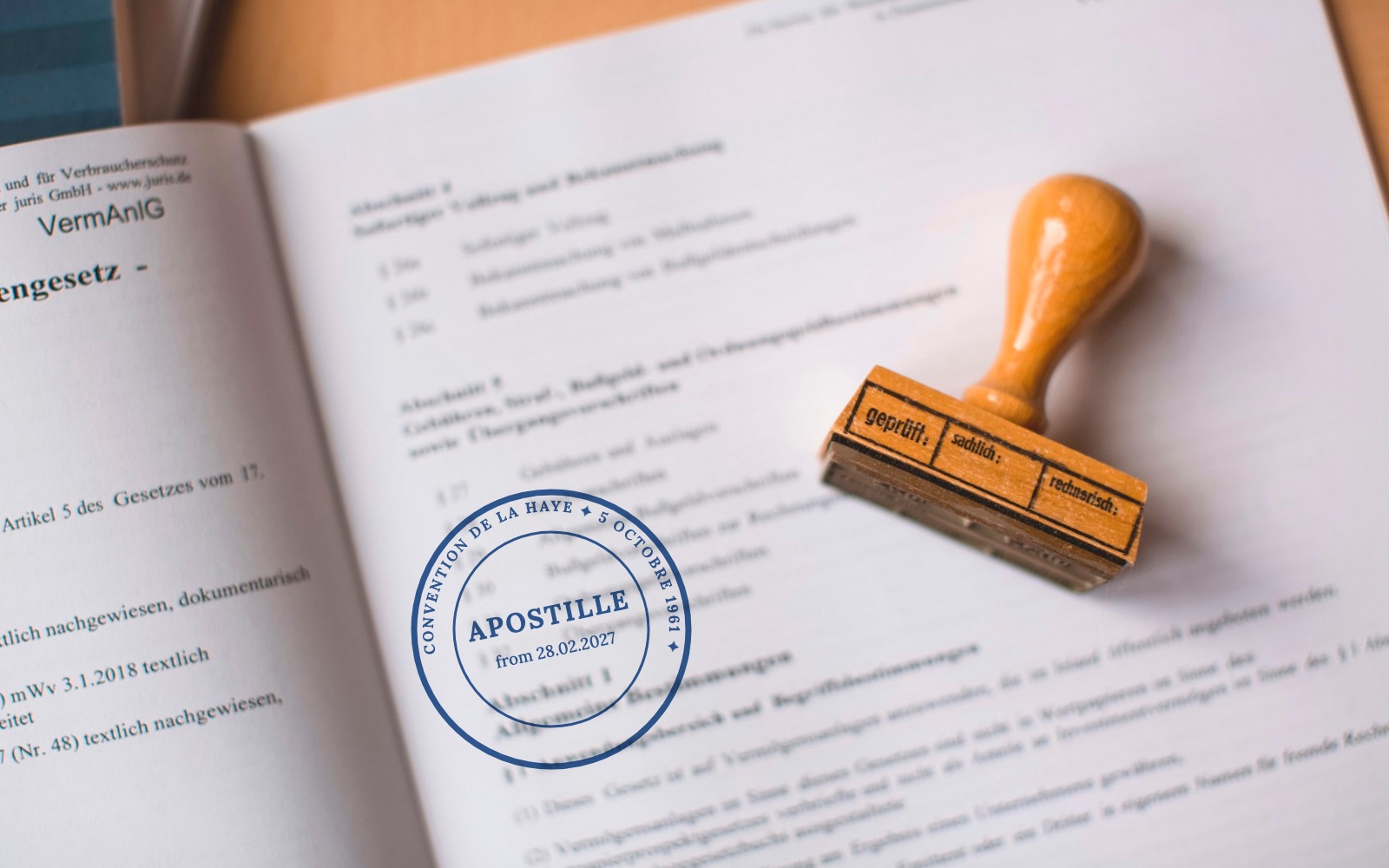

Does Thailand issue apostilles?
Not yet. Thailand joined the Apostille Convention on 30 June 2026, and the Convention enters into force for Thailand on 28 February 2027. From that date, a Thai public document gets one apostille certificate and can be used directly in the other member countries, such as Belgium, the Netherlands and France, without legalisation by their embassy. Until then, the current legalisation steps still apply.
Spoyzy in Bangkok legalises and translates documents for Thai–European families today, and will handle apostilles from 2027.
If you have ever prepared Thai documents for a visa, a marriage or a residence permit in Europe, you know the chain: translation, the Thai Ministry of Foreign Affairs, then the embassy. In 2027 this becomes simpler. This guide explains what an apostille is, what changes on 28 February 2027, what stays the same, and how to plan if you need documents in the coming months.
In short
- Today (until 27 February 2027): Thai documents for Europe are legalised by the Thai Ministry of Foreign Affairs, then usually by the embassy of the country where you will use them.
- From 28 February 2027: one apostille from the Thai authorities replaces that chain for countries in the Convention.
- The same applies the other way: Belgian, Dutch or French documents for Thailand will need an apostille from their own country instead of legalisation by the Thai embassy.
- An apostille does not replace a translation. Authorities may still ask for a certified translation.
- Thailand has not yet published the details (issuing office, procedure, electronic or paper). We will update this guide when it does.
Why families choose Spoyzy
- 500+ documents legalised for Thai–European couples and families.
- We know both sides: the Thai Ministry of Foreign Affairs and what European authorities expect.
- We speak your languages: Thai, English, French and Dutch.
- Rated 5.0 ★ on Google by our clients.
1. What is an apostille?
An apostille is a standard certificate, created by the Hague Apostille Convention of 1961. It confirms that the signature and stamp on a public document are genuine. A document with an apostille can be used in every other member country without any further legalisation by an embassy or consulate.
More than 120 countries are members, including Belgium, the Netherlands, France, Germany, the United Kingdom, the United States and Australia. With Thailand, the Convention has 130 Contracting Parties.
The apostille only covers the origin of the document (signature, stamp, official’s capacity). It does not check or approve what the document says, and it does not translate it.
2. Thailand’s timeline
| Date | What happened |
|---|---|
| 9 December 2025 | The Thai Cabinet approved accession to the Apostille Convention. |
| 30 June 2026 | Thailand deposited its instrument of accession in The Hague. |
| Until about 30 December 2026 | Other member countries can object to Thailand’s accession (6 months). As of 12 October 2026, the HCCH lists no objections. |
| 28 February 2027 | The Convention enters into force for Thailand. |
If a country objects, the Convention would not apply between that country and Thailand, and the old legalisation chain would continue for it. We will check the official HCCH status table again in January 2027.
3. Thai documents for use in Europe
Today (until 27 February 2027)
- Get the official Thai document (for example a birth certificate, marriage certificate Kor Ror 2/3, divorce certificate, house registration extract or criminal record).
- Have it translated by a certified translator.
- Have the document and its translation legalised by the Department of Consular Affairs of the Thai Ministry of Foreign Affairs.
- Where required, have them legalised again by the embassy of the destination country in Bangkok. For Belgium, the embassy’s visa checklist asks for documents and translations to be legalised by the embassy before the visa application.
From 28 February 2027
- Get the official Thai document.
- Get an apostille from the Thai competent authority.
- Use it directly in Belgium, the Netherlands, France or any other member country. No embassy legalisation.
A translation is still likely to be needed, because the receiving authority must be able to read the document. How translations will be handled together with the Thai apostille has not been published yet.
4. European documents for use in Thailand
The change also works the other way, for example for a Belgian certificate of non-impediment (CNEM), a birth certificate, a divorce judgment or a criminal record used in Thailand.
| Today | From 28 February 2027 | |
|---|---|---|
| Belgian document | Legalisation by the FPS Foreign Affairs in Brussels, then by the Royal Thai Embassy | One apostille from the FPS Foreign Affairs (Belgian apostilles are electronic) |
| Dutch or French document | Legalisation in the issuing country, then by the Thai embassy | One apostille from the issuing country’s authority |
| In Thailand | Thai translation, legalised by the Thai Ministry of Foreign Affairs | A Thai translation will most likely still be required; details to be confirmed by the Thai authorities |
Note: documents issued by an embassy in Bangkok (for example a certificate of freedom to marry signed by a consul) are not covered by the Convention. Those will still follow the legalisation route at the Thai Ministry of Foreign Affairs.
5. Which documents can get an apostille?
The Convention covers public documents issued in a member country:
- civil status documents: birth, marriage, divorce and death certificates, name change certificates;
- documents from courts and judicial officers, such as divorce judgments;
- administrative documents, such as house registration extracts and criminal records;
- notarial acts;
- official certificates placed on private documents, such as a certified signature or a certified copy.
Not covered: documents executed by diplomatic or consular agents, and administrative documents dealing directly with commercial or customs operations. Private documents (a letter, a CV, a contract) need to be notarised or certified first.
6. Should you wait for February 2027?
- You need the documents before March 2027 (visa appointment, wedding date, residence application): do not wait. Use the current legalisation route.
- Your deadline is after March 2027: waiting may save you the embassy step. Allow extra time in the first weeks, as new procedures often start slowly.
- Your documents are already legalised: keep them. Check with the receiving authority how recent the documents must be; many ask for documents issued within the last 3 or 6 months.
Not sure which route fits your timing? Send us your destination country and deadline on WhatsApp. We will tell you whether to legalise now or wait for the apostille.
7. What stays the same
- Translations: authorities in Belgium, the Netherlands, France and Thailand still need to read your documents.
- Countries that are not members of the Convention: the legalisation chain continues.
- Receiving authorities still decide what they accept, for example how recent a document must be.
- Names must be spelled the same way on every document and translation.
8. How Spoyzy can help
We have legalised more than 500 documents for Thai–European couples and families, in Thai, English, French and Dutch:
- legalisation at the Thai Ministry of Foreign Affairs and the embassies, today;
- apostilles for Thai documents, as soon as the Thai procedure opens on 28 February 2027;
- certified translations Thai ⇄ English, French and Dutch;
- advice on the right route and timing for your visa, marriage or residence file.
Free document check
Send us a photo of your documents and tell us where you will use them. We reply with the steps you need, today or after February 2027.
Frequently asked questions
Can I get an apostille on a Thai document now?
No. Thailand will issue apostilles from 28 February 2027, when the Convention enters into force for Thailand. Until then, Thai documents are legalised by the Department of Consular Affairs and, where required, by the destination embassy.
Who will issue apostilles in Thailand?
The Thai authorities have not yet published the official competent authority and procedure. The Department of Consular Affairs of the Ministry of Foreign Affairs, which handles legalisation today, has been preparing for the Convention. We will update this guide when the procedure is announced.
Will I still need the Belgian embassy in Bangkok to legalise my Thai documents?
For Thai public documents with an apostille, no: from 28 February 2027, Belgium must accept them without embassy legalisation, unless Belgium objects to Thailand’s accession (no objection listed as of 12 October 2026).
Does an apostille replace a translation?
No. An apostille only confirms the signature and stamp. If the document is in Thai, the authority in Europe will usually still ask for a certified translation, and Thai authorities will ask for a Thai translation of foreign documents.
Are documents legalised before February 2027 still valid?
The legalisation itself does not expire, but many authorities only accept documents issued in the last few months. Check the rules of the authority that will receive them.
Does the apostille apply to the UK, the US and Australia?
All three are members of the Convention. From 28 February 2027, Thai public documents with an apostille can be used there without embassy legalisation, and their documents with an apostille can be used in Thailand, unless an objection is filed.
Related guides: Marriage registration in Thailand · Family reunification in Belgium · Schengen visa from Thailand · Invitation letter for a visa

Written by Poy, founder of Spoyzy
Poy has handled 125+ visa cases, 100+ marriages and 500+ document legalisations for Thai–foreign couples and families. Poy speaks Thai, French and English (and a little Dutch), and explains every document to both partners in their own language.
Ask Poy on WhatsAppLast updated: October 2026